- Premium Content It takes our newsroom weeks - if not months - to investigate and produce stories for our premium content. You can’t find them anywhere else.
 Scott Shuey · · 7 min read
Neptune’s rising: AI robots help ships save fuel, cut emissions
You might expect that a 500 kilogram, AI-powered robot named Magneto would be a little more intimidating. Instead, it looks like a bumper car, complete with wheels and a bright orange paint job.
But that’s because you’ve never seen Magneto drive vertically up the side of a 130-foot tall bulk carrier ship, blasting away barnacles and other types of biofouling with its high-powered water jets.
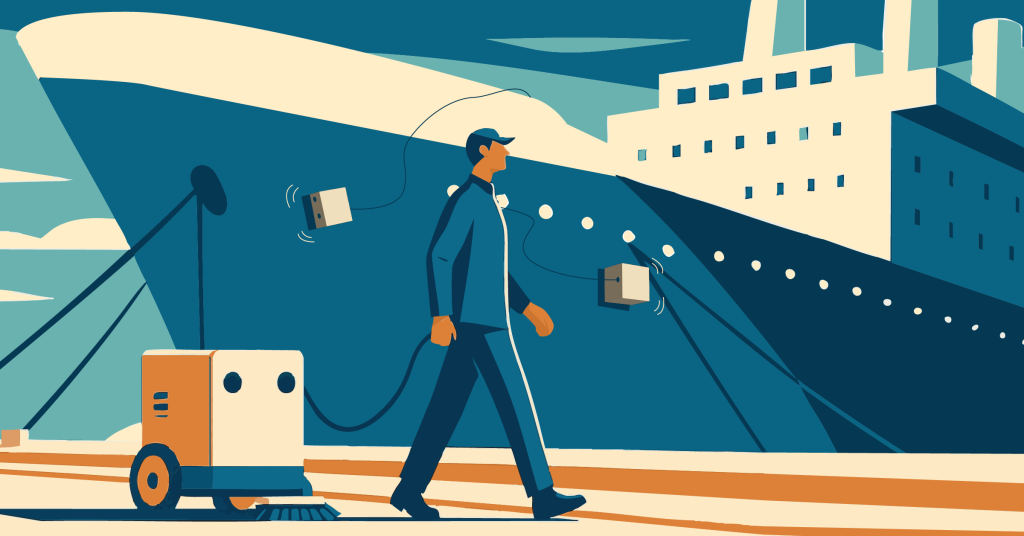
Image credit: Arsal Ysfin
Well, you’re not going to see that either because Magneto operates underwater, and usually while the ship is at anchorage, sitting far offshore.
If you could set eyes on Magneto, what you would see is a magnetic body clinging to the steel plating of ships while it works its way through a grid pattern with the help of a pilot. You probably won’t notice him either – he’ll be sitting in a boat working on a computer that allows him to communicate with the robot.
But despite the lack of public visibility, Neptune – the company that offers Magneto-as-a-service – has already expanded from having a single client in Hong Kong to serving 61 ports across China and Singapore.
Customers pay for completed ship cleanings rather than buying or maintaining machines. The company is now looking to expand to more than 100 ports worldwide, all with an eye on going public later this decade.
Neptune Robotics, founded in 2019, is the brain child of CEO Elizabeth Chan, CTO Jacky Im, and Kate Ma, who is the firm’s chief of operations. When the trio started out, none of them had experience in shipping – or had even stood beside a cargo vessel.
Chan tells Tech in Asia that the three formed a team after watching the Tham Luang cave rescue, which involved sending robots to Thailand to help rescue the kids trapped in the cave.
“But even that robot failed,” Chan says. “I thought, wow, underwater robotics must be a very challenging and difficult thing because even the SpaceX and Tesla owner doesn’t have a robot that could rescue the kids underwater.”
From the stock exchange to the sea
Chan trained in economics at Cambridge and worked as an analyst at the Hong Kong Stock Exchange, reviewing IPOs. The experience left her determined to start her own business, but she knew her chance wouldn’t be in finance alone.
She retrained in software development and joined a London startup before entering a founders’ accelerator program in 2018.
There, she met Jackie Im, now Neptune’s chief technologist, who was showing off a small underwater robot he had designed. Chan partnered with Im and later recruited her former classmate Kate Wong as operations chief.
To find their first customer, the trio sent hundreds of cold emails to anyone connected with underwater work, “including bridge work, swimming pools, reefs, oceans, anything we could think of.”
AI to scrub a ship?
Rebuilding the bot
Stay ahead in Asia’s tech landscape
This is premium content. Subscribe to read the full story.
Neptune Robotics’ 500 kilogram robot climbs ships to blast away biofouling – helping cut fuel costs – as the firm races toward IPO.
We know this is not ideal. ⌛ Sign up in 20 seconds. Cancel anytime.
Our subscriber community includes professionals from these companies:





Stay updated on the go with our mobile app.
Get latest insights with smoother, more personalized experience through TIA mobile app.









📅 Upcoming Events
22 October 2026
Payoneer x CSPN Summit 2026