- Insights This article was written by a TIA community member. Insights pieces undergo the same rigorous editorial process that newsroom-produced articles have.
 Hans Tung · · 7 min read
This new retail startup is dubbed China’s Amazon Go, but with a key difference
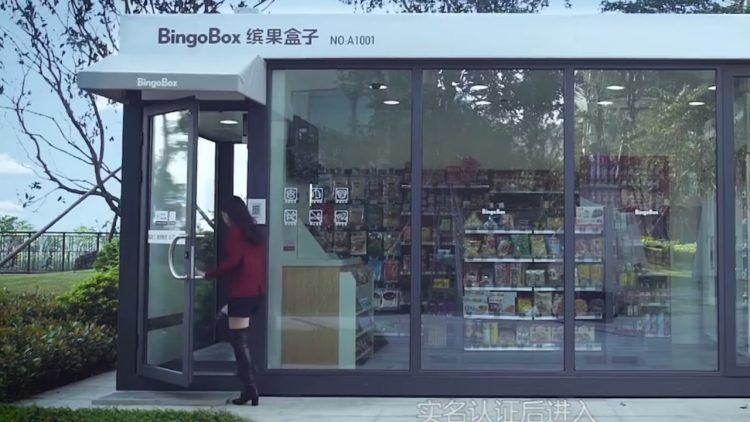
Photo credit: BingoBox
This article is part of Tech in Asia’s partnership with GGV Capital’s 996, a podcast about tech and entrepreneurship in China hosted by Hans Tung and Zara Zhang. This is heavily revised from the original show transcripts. For the full interview, go here. You can also listen to the 996 Podcast by searching “996” in any podcast app.
Zilin Chen is the founder and CEO of BingoBox, a 24-hour cashier-free convenience store in China and a GGV Capital portfolio company.
BingoBox features a staff-less smart checkout counter, RFID and computer vision to keep track of items, QR code scanning for users to enter the store, and Alipay and WeChat Pay payment support. It is one of the first movers in a phenomenon known as “new retail” in China, which is commonly understood as using technology to transform offline retail.
In this interview, Chen discusses how the idea for BingoBox came about, how it differs from Amazon Go, and the technology and unit economics behind the stores.
Tell us about your background before you founded BingoBox.
Before I founded BingoBox, I was working in advertising at Ogilvy. I helped my clients solve marketing problems, sell products, and diagnose channel problems. At that time, I knew that channels are very important to manufacturers.
Early in 2013, I began to think about developing a new channel where clients could bring their products to consumers in a highly efficient way and at very little cost. At the end of 2013, I started BingoFresh, an ecommerce platform selling fruits through WeChat.
That business worked quite well. But after pre-A financing, I felt that it was hard to grow quickly because we were not the leading company in China in that category. At the same time, I was thinking about how I could lower the delivery cost to make BingoFresh outstanding and competitive. I also wanted to raise another round of financing.
So, my initial idea was to put refrigerators inside the communities where we would deliver our fruits. I also thought, “Why not sell some things that are easy to stock and with a long shelf life?” Then, I came up with an idea: since we were selling products in refrigerators, why don’t we just do it in a community store. That was the initial idea for BingoBox.
BingoBox is dubbed “the Amazon Go of China.” Was Amazon Go an inspiration and how is it different from your product?
I launched BingoBox in 2016, and Amazon Go was released in December 2016. But at that time, we had already been operating for four months. So, there’s no way I had any idea of Amazon Go when we were developing BingoBox.
I think we are very different from Amazon Go. From the very beginning, we were aiming to solve a different problem. We are creating a highly efficient channel and a new way for consumers to shop. Amazon Go is all about enhancing the efficiency of their old shopping environment. It is a cashier-free store, but they have people doing merchandising.
From my understanding, in the US, cashiers are paid highly, and the stores pay a lot of rent. When people come through during peak hours and see a long line, they give up and drive to another store because they have a lot of choices.
I think that’s the pain point they are solving, but we have a different direction and target.
Could you walk us through the technology you’re using?
In the beginning, we had no research power yet to do computer vision. So, we used RFID, which is a cheap and mature technology, to build our unmanned community store system.
Can customers call for help if anything goes wrong?
Can you tell us about the unit economics?
Can you tell us more about your new product called BingoBox Mini?
What do you think about working or competing with Alibaba and Tencent, which are very aggressive in new retail?
Now, to dive deeper into the new retail space, here are some insights from Eric Xu, managing partner at GGV Capital.





Stay updated on the go with our mobile app.
Get latest insights with smoother, more personalized experience through TIA mobile app.













📅 Upcoming Events
22 October 2026
Payoneer x CSPN Summit 2026