 Adinda Pryanka · · 3 min read
Spacetech startup Aliena raises $5.5m to expand into Europe
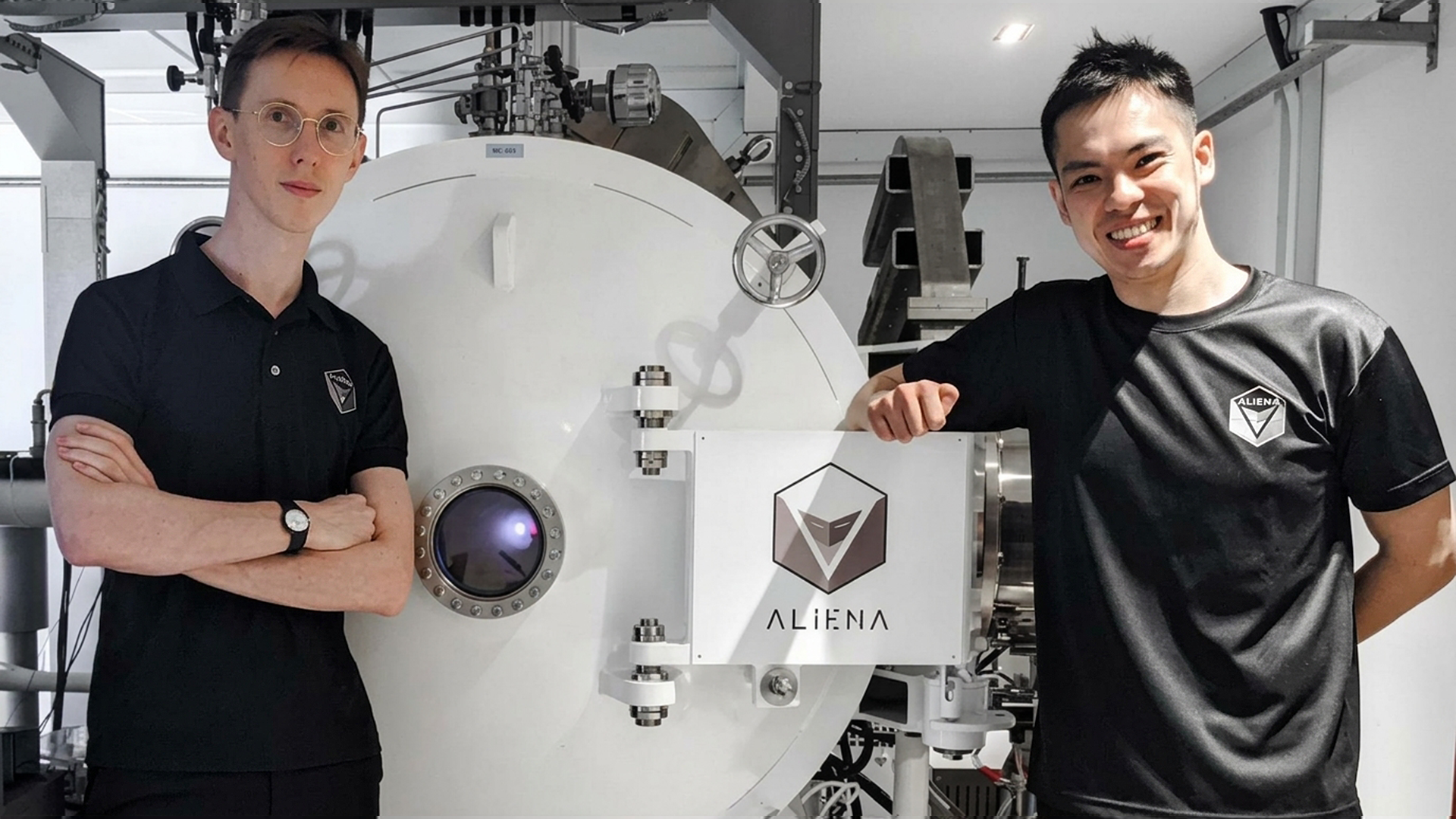
Aliena CTO George-Cristian Potrivitu (left) and CEO Mark Lim / Photo credit: Nanyang Technological University
Spacetech startup Aliena has raised US$5.5 million in a series A1 round led by investment firm In Group Holdings. Existing investors including Wavemaker Partners and workforce management firm LotusOne also joined the round.
Singapore-based Aliena said it would use the funds for research and development as well as production. It is also eyeing expansion in the European Union, where it plans to open an office by early 2027.
Founded in 2018 by Mark Lim and George-Cristian Potrivitu, Aliena develops Hall effect thrusters, a type of electric propulsion engine that keeps satellites in position over long space missions. The duo met while working on their doctorates at the Space Propulsion Centre of Singapore’s Nanyang Technological University.
“You can think of us like the Rolls-Royce for satellites,” Lim told Tech in Asia. Just as Rolls-Royce engines power planes from Airbus, Boeing, and Bombardier, Aliena wants to supply engines to any satellite maker or operator and become the industry standard.
Aside from Asia, Aliena’s primary market is Europe, where it serves the most customers and competes with firms like France-based ExoTrail.
In addition to thruster units, Aliena sells full propulsion systems. The company owns the intellectual property for every subsystem within an engine, which lets it build customized propulsion systems for niche space missions.
Globally, there is a shorfall of Hall thrusters, Lim shared. Sanctions have cut off the supply of Russian-made engines, while thruster shortages have delayed some US defense programs.
Consequently, major US defense contractors have acquired local thruster manufacturers to be better placed to bid for government contracts, Lim said. Across Europe, more firms are looking to build satellite networks without relying on US suppliers, he added.
In Asia, Aliena’s biggest customers are in South Korea. One such client is satellite maker Kairo Space, which is building a mission for the Korea Aerospace Research Institute.
Aliena said it has also sold a customized system that combines four of its main thrusters to South Korean customers.
The startup’s long-term goal is to develop a standard, off-the-shelf thruster that customers can install without custom engineering. While Aliena already has a standardized system, its newer, higher-power products are still largely built to order at first, and many of its past projects have been customized, Lim said.
The company also uses different sales arrangements depending on the product. Components and subsystems are loaned to customers and sold only if a mission flies, while full systems are sold outright.
Filling a gap in the market
Aliena offers two thruster classes – 100 watts and 300 watts – and is developing a third near the kilowatt range. A higher wattage provides more thrust but also requires more power from the satellite. As such, the 100-watt class goes with smaller satellites while the 300-watt class suits larger ones.





Stay updated on the go with our mobile app.
Get latest insights with smoother, more personalized experience through TIA mobile app.












📅 Upcoming Events
22 October 2026
Payoneer x CSPN Summit 2026